What is healthcare simulation?
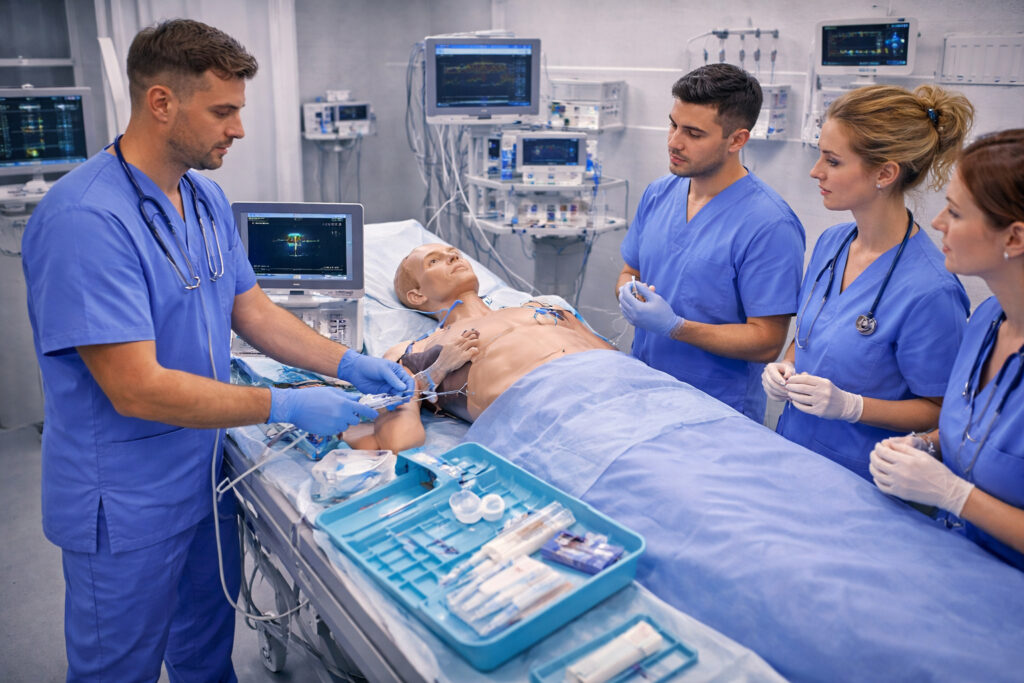
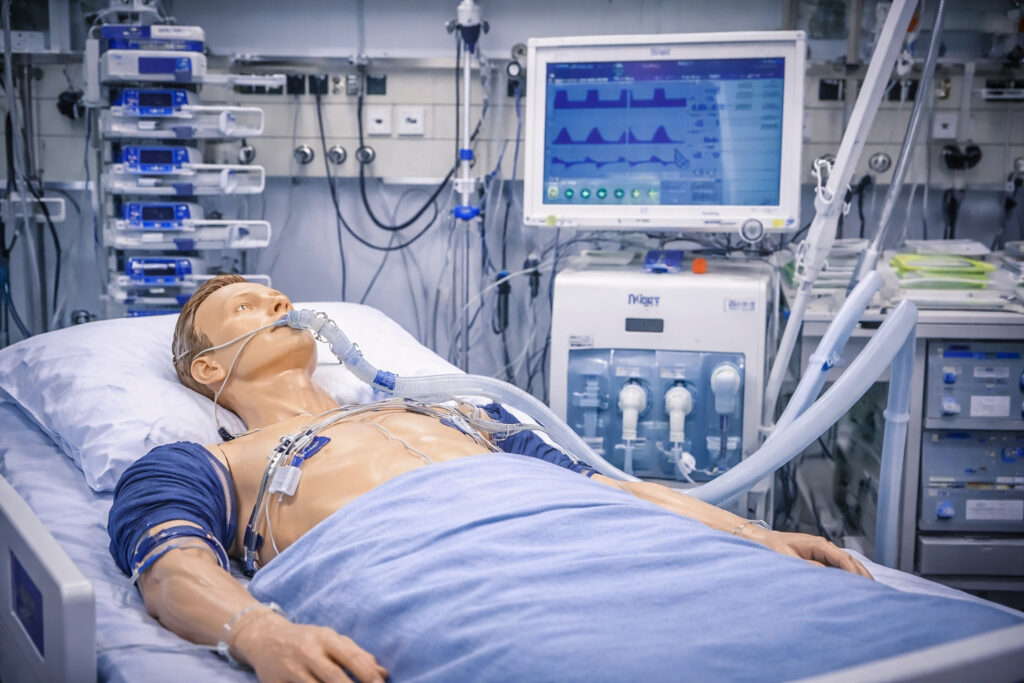
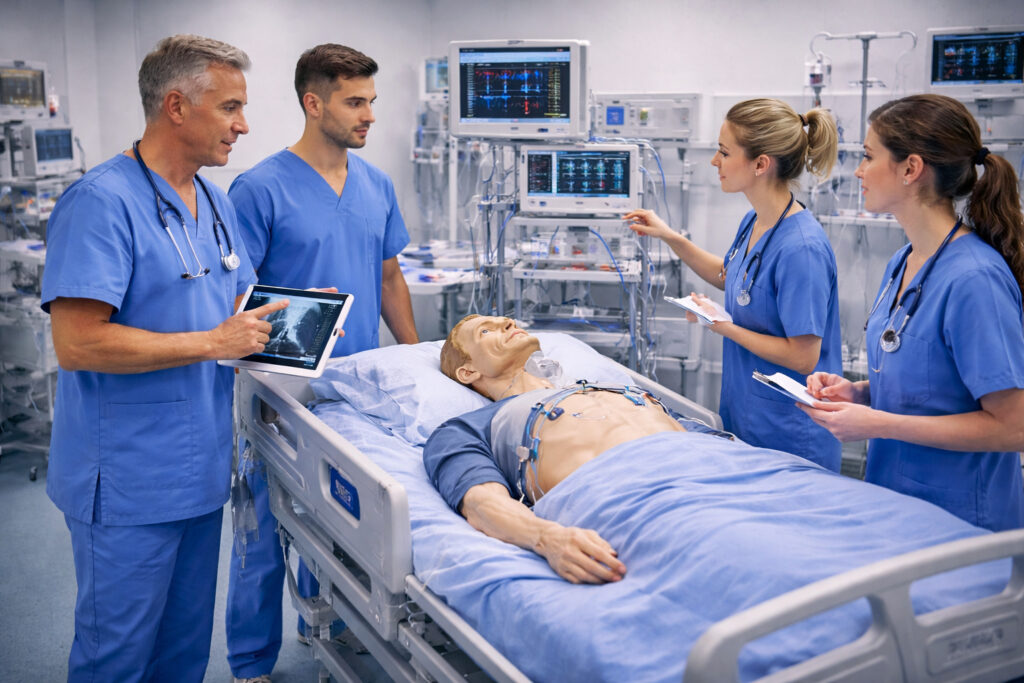
Healthcare simulation is realistic training and reflection on staged events from clinical work. With the help of healthcare simulation, healthcare personnel can train on relevant and challenging situations from their own working day. The patients have been replaced with simulators (manikins) or markers. We create a risk-free environment where you and others can improve communication and interaction to become an efficient and safe functioning team.Healthcare simulation is practical training for healthcare professionals and deals with everything from individual skills training to multidisciplinary team training in acute and complex situations.
The training gives healthcare personnel the opportunity to practice better competence in patient treatment, without the patient being involved in the training. In the simulation, the patient is an advanced manikin or a marker that responds to the treatment performed by the participants.
In healthcare simulation, the training is arranged so that the participants encounter patient situations that are realistic and suitably challenging. The form of exercise is therefore perceived as relevant and useful. Examples of goals for the training may be to practice better technique during procedures or patient conversations, the introduction of new guidelines or that the course participants will become better at clear communication and good interaction.
Healthcare simulation is a suitable form of training both for individual training as well as for training large teams. In full-scale simulation, entire teams are trained in complex patient situations. The team consists of those who naturally interact in the situation at hand. After the scenario, everyone meets for a debriefing where the team reflects on what happened in the scenario. The debriefing is led by a facilitator.
The debriefing is a structured conversation where the team together reviews what challenges they faced in the scenario, what went well and whether they see anything that could have been done in a better way. This reflection is rounded off with all participants concretizing what they have learned from the training session and how this can make them better in further work.
The goal of the training is to improve patient safety. Health simulation helps to increase the competence of the individual participant while the interaction creates competent teams that know what needs to be done and in what way.
We are also in the process of accreditation for bachelor's and master's level teaching. In addition, at the same time we are in the process with the relevant national and international bodies.
As regards to translational simulation, which is how simulation is connected directly with health service priorities and patient outcomes, through interventional and diagnostic functions, we strive to deliver better healthcare outcomes through improved simulation delivery techniques and the development of healthcare practitioners who can use simulation for their everyday quality improvement.
By translational simulation we aim to:
- Identify, across clinical domains, how simulation impacts high performing teams and the provision of clinical care;
- Advance the understanding of how translational simulation impacts organisation culture and patient outcomes; and
- Collaborate with local, national and international groups seeking to identify best practices, novel methods and sustainability of efforts.
Courses
 EN
EN  AL
AL