
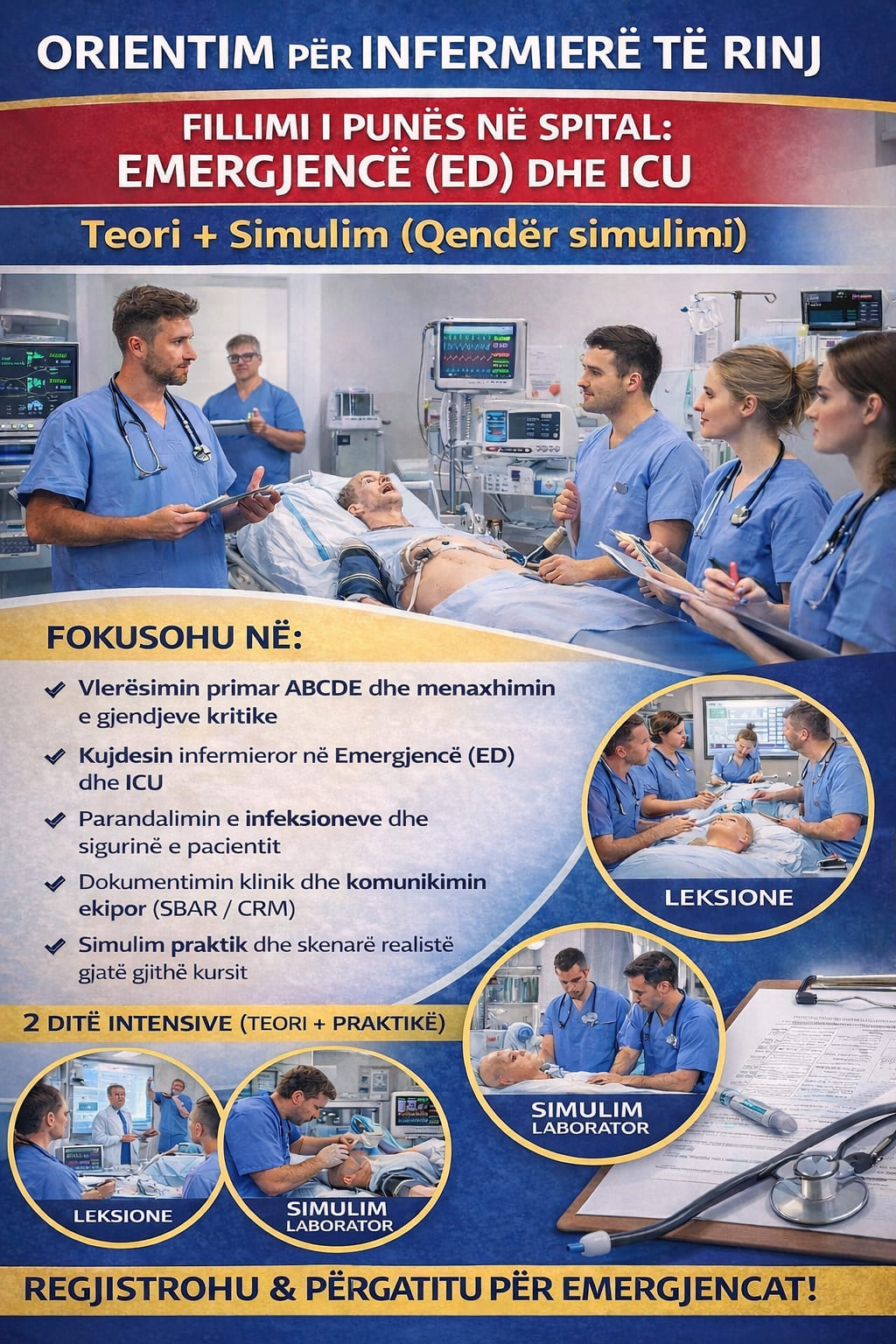
Course Objective:
To prepare newly graduated nurses to begin working in a hospital setting, particularly in the Emergency and ICU, focusing on primary assessment (ABCDE), patient safety, infection prevention, documentation, team communication, and initial management of acute exacerbations through practical stations and simulation sessions with debriefing.
| Duration | 2 days (Saturday + Sunday) | 20 participants |
| Location | Simulation center (classroom + skills lab + simulation room) |
| Target group | Newly graduated / early-career nurses (ED, ICU, reparts) |
| Methodology | Short theory + practical stations (task-trainers) + team simulations + debriefing (CRM) |
| Learning balance | About 45% theory, 55% practice/simulation (rotation in 4×5 teams) |
| Assessment | Pre-test & post-test (short) + OSCE checklist + SBAR communication assessment |
Learning Objectives (by the end of the course):
- Perform the primary ABCDE assessment and recognize signs of clinical deterioration (e.g., hypotension, hypoxia, tachycardia, changes in GCS).
- Apply basic patient safety measures: patient identification, the “5 rights” of medication administration, double-checking high-risk medications, and incident reporting.
- Implement infection prevention and control measures: hand hygiene, use of PPE, isolation precautions, and basic care bundles (VAP/CAUTI/CLABSI – concept).
- Use basic ED/ICU equipment: EKG/SpO₂/NIBP monitoring, oxygen therapy (nasal cannula/mask/non-rebreather), suction, and bag-valve-mask (BVM) basics.
- Perform basic nursing procedures: peripheral IV cannulation (PIV), blood sampling (mock), preparation of infusions, and basic use of infusion pumps.
- Recognize common emergencies and provide initial management: anaphylaxis, suspected sepsis, respiratory failure, hypoglycemia, arrhythmias, and cardiac arrest (BLS/AED).
- Complete structured documentation and handover (SBAR) and work effectively in a team with clear roles during resuscitation.
Apply for this course
 EN
EN  AL
AL